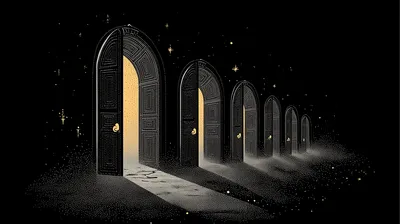
You wake up with the distinct sense that something happened in the night — a mood, half an image, a story already dissolving — and by the time you reach for it, it is gone. Or you wake with nothing at all, and decide you simply don’t dream. If this is you, here is the first thing to know: you almost certainly are dreaming, several times a night. The problem is not that your dreams are missing. It is that they were never saved.
This article explains why dreams are so easy to lose, walks through the seven most common reasons you can’t remember them, and answers the question quietly underneath all of it: is this normal? (It is.) Then it covers the part most people never hear — that recall is a skill you can train, starting tomorrow morning.
You are built to forget your dreams
Forgetting a dream is not a glitch. It is the default your brain is wired for.
Most dreaming happens during REM sleep, and REM is a strange neurological state for memory. The prefrontal cortex — the region that organizes experiences into structured, retrievable memories — is largely offline. At the same time, the brain chemistry that normally locks an experience into long-term storage sits at its lowest point of the entire day. So a dream plays out as a vivid, fully felt experience that your sleeping brain has almost no machinery to record. It runs in full color, then fails to write the file.
That is why remembering a dream is the exception that takes effort, not the rule you should expect by default. With that framing, the reasons you forget stop feeling like personal failures and start looking like fixable conditions.
The 7 reasons you can’t remember your dreams
1. You wake up too abruptly
If one moment decides a dream’s fate, it is the way you cross from sleep into waking. A loud alarm pulls you straight out of REM and floods you with urgency and sensory input — the opposite of the calm, still state recall needs. Jolt awake, and the dream is gone before you are upright. Wake gradually, and far more of it survives.
2. You move and reach for your phone in the first minute
A dream lives in fragile short-term memory for only a brief window after you wake. Physical movement triggers the switch from sleep-memory to waking-memory, and a screenful of notifications hijacks the exact attention the dream needed to resurface. Checking your phone first thing is the single most common recall-killer there is.
3. You’re not getting enough REM
Your REM periods get longer and more vivid across the night, with the richest ones concentrated in the final two to three hours of sleep. Cut your night short, keep an irregular schedule, or routinely sleep too little, and you lop off exactly the dreams you would be most likely to remember. Less REM simply means less dream to recall.
4. Alcohol and certain medications suppress your dreams
Alcohol is a well-known REM suppressant: drink before bed and you spend less of the night in the dreaming stage, so there is literally less dream content to wake up to. Several common medications do the same — some sleep aids, and certain antidepressants in particular, are known to blunt or alter REM and dream recall. If your dreams vanished around the time you started a new prescription, that is a plausible cause worth noting, and worth raising with your doctor rather than acting on alone.
5. Stress and a racing mind on waking
Recall needs a few seconds of quiet. If you surface straight into anxiety, a mental to-do list, or the day’s pressures, your attention is pulled forward before the dream can drift back. Chronic stress also fragments sleep quality overall, which compounds the problem.
6. Your individual brain wiring
Some people are simply lower dream-recallers, and a good part of that is physical. Research has linked higher dream-recall frequency to greater white-matter density in the medial prefrontal cortex, and EEG studies have found that the brainwave pattern at the moment of waking predicts whether a dream gets recalled at all — people who wake more often and more lightly during the night tend to remember more. None of this is fixed destiny. It just means some of us start from a lower baseline and benefit more from deliberate practice.
7. You’ve stopped paying attention to them
Recall is, in part, a trained habit. If you have spent years treating dreams as noise, your brain has learned they are not worth holding onto. The moment you start treating them as worth keeping — by capturing them, even partially — that learning begins to reverse. Inattention is a cause, which is good news, because attention is something you control.
Is it normal to not remember your dreams?
Yes — completely. Not remembering your dreams is one of the most common sleep experiences there is, and on its own it signals nothing wrong with your brain, your sleep, or your mental health. Almost everyone dreams every night during REM; “I don’t dream” is, in nearly every case, “I don’t remember dreaming.” The dreams are happening. They are just not being saved.
There is even a counterintuitive twist: people who sleep very soundly and rarely stir often recall fewer dreams than lighter sleepers, because brief awakenings are part of what gets a dream into memory. So poor recall can actually go hand in hand with deep, uninterrupted sleep. Forgetting your dreams is not a problem to fix for your health — it is only worth changing if you want access to them.
The good news: recall is a skill you can train
Here is what surprises most people: dream recall responds to practice, fast. People who are certain they never remember anything routinely go from blank mornings to fragments to full narratives within one to two weeks, using nothing more than a few small habits. Almost all of those habits come down to protecting that fragile window right after you wake: waking gently, staying still, keeping your phone out of reach, and capturing the dream the instant it is in your grasp.
If you want the full playbook, see our guide to how to remember your dreams, which breaks down the eight most effective techniques in order of impact. And once you are recalling regularly, the patterns start to surface — recurring images, repeated scenarios — which is where dreams get genuinely interesting, and where what your recurring dreams are trying to tell you picks up.
Frequently asked questions
Is it normal to not remember your dreams?
Yes. It is extremely common and, by itself, says nothing bad about your sleep or your mind. Almost everyone dreams several times a night; not remembering simply means the dreams were not transferred from fragile short-term memory before you woke fully.
Does everyone dream, even if they don’t remember?
Yes. Dreaming during REM sleep is near-universal. “Not dreaming” is almost always “not remembering.” The dreams are occurring. They are just not being saved.
Why did I suddenly stop remembering my dreams?
A sudden drop usually points to a change in your sleep or routine: more stress, less or more irregular sleep, increased alcohol, or a new medication, since some sleep aids and antidepressants suppress REM. Waking to a harsher alarm or grabbing your phone first thing can do it too.
Does not remembering your dreams mean you sleep well?
Sometimes, yes. Deep, uninterrupted sleepers often recall fewer dreams, because brief night-time awakenings are part of how a dream gets into memory. Poor recall is not a sign of a sleep problem on its own.
Can you train yourself to remember your dreams?
Absolutely. Recall is a skill, not a fixed trait. Setting the intention to remember before sleep, staying still on waking, and recording the dream immediately will, for most people, produce a clear improvement within one to two weeks.
Catch your dreams before they fade
The hardest part of dream recall is the first sixty seconds, when you need to hold onto a dissolving dream without fully waking yourself up. Dreama is built for exactly that moment. Keep it on your nightstand, and the instant you wake, just talk. Voice-first capture lets you record a whole dream in seconds, eyes still closed, before it slips away. Once you are remembering night after night, you can start to notice what your dream symbols actually mean.
Download Dreama on the App Store or Google Play